In the 11th century, the Benedictine Monastery of Santa Maria, from which the village took its name, had vast estates and increasingly assumed a prominent place in the history of the territory of Aquileia, influencing the religious, economic and social fortunes of all the surrounding areas.
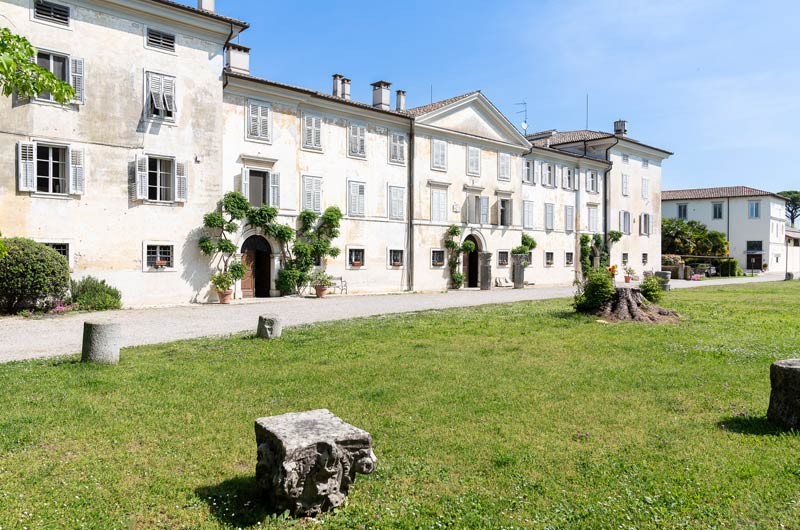
In 1782, the ecclesiastical complex was sold to the Cassis Faraone family who transformed the Benedictine Monastery into a villa-farm.
In 1850, the estate was purchased by the family of Giulio Ettore Ritter de Záhony, originally from Frankfurt am Main. The Baron and Ritter de Záhony together with their son Eugenio, transformed the Monastero estate into an innovative agricultural company, dedicated to research and experimentation of new viticulture management techniques and the nursery production of rooted vines (one and a half million a year) exported throughout the Austro-Hungarian Empire.
Undoubtedly, the success of Baron Ritter de Záhony’s wine was also favored by the union of his daughter Elvine with Count Theodor de la Tour, a member of an ancient and noble French family of Catholic religion. In fact, in 1877, Elvine’s father gave the newlyweds as a dowry the substantial plot of land in Russiz, among gentle slopes in the heart of the Collio Goriziano.
The history of the ancient Ritter de Záhony family is imprinted in the history of the area for its excellent industrial activities. In Gorizia, where the Ritters worked cotton and silk, they built the Straccis workers’ colony. In Trieste, Giovanni Cristoforo Ritter de Zahony was among the founding members of Assicurazioni Generali and became its first President.
The Monastero residence in Aquileia opened to a series of illustrious guests who between 1863 and 1915 left their signature on the »Family Diary«. Among them, Archduke Charles Louis, hosted on the night of August 2, 1882 when he was in Aquileia to inaugurate the newly founded C. R. State Museum; Archduke Ranieri, governor of Lombardy-Veneto, guest of honor at an afternoon tea celebrated by local chronicles in 1890; and finally Frederick Augustus of Saxony, who arrived by car from Trieste in 1910.
The values transmitted by the Ritter de Zahony family have arrived unchanged over the centuries to Guido Federico Rossignoli who directly manages the family business with a credo that allows the continuity of a job, where the grapes are processed in cutting-edge cellars, in continuous dialogue with the territory.