
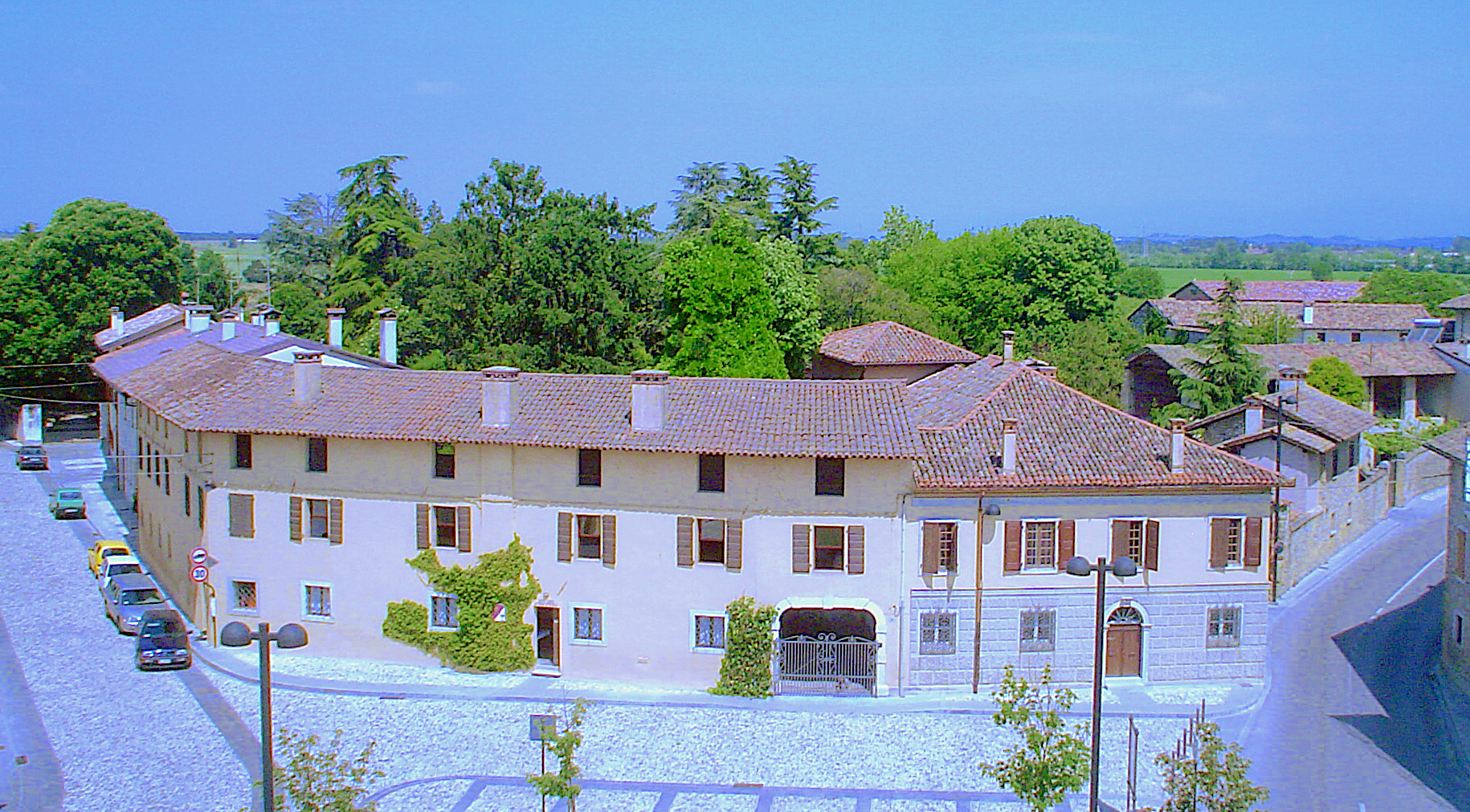
The Calligaris manor complex now Foffani is among the most prominent in the square of Clauiano, one of the most beautiful villages in Italy. The village is mainly made up of small buildings and houses from the eighteenth century or transformed in that period, an excellent example of traditional and rural Friulian architecture. The main house and the annexed buildings, which today are almost in the same configuration as an ancient map of 1774, have always been inhabited by the Calligaris family, as shown by documents dated 1608 and 1687.
Today, the only owner is Giovanni Foffani, son of Maria Calligaris.
The complex is an example of bourgeois country architecture, historically intended for the manor farm and in particular for the production of wine (officially documented since 1789) and for the breeding of silkworms.
In 1704, part of the courtyard was sold, and the “turret” was built, now used as a charming holiday home (Casa Antica Mosaici), with the old wooden stairs and stucco from the period on the first floor ceilings.
During the Second World War, the house was first the headquarters of the German command of the area and then of the American one.
The garden always amazes with its centuries-old wisteria, which has climbed up the nearby trees. Difficult to capture with a single image, it should be discovered little by little for its shapes and its scent between April/May, before the petals of its flowers fall and form a soft, purple carpet over the gravel for a few days.
Before visiting the cellar, a walk in the garden is pleasant, which is characterized, in addition to the wisteria, by a widespread presence of climbing plants on the walls, mainly ivy. In the largest part, towards the vineyard, you will find centuries-old trees, such as the Lebanese cedar, the magnolia and silver pines. They complete and close the spaces with privet, lime and hackberry trees, all around the large garden.